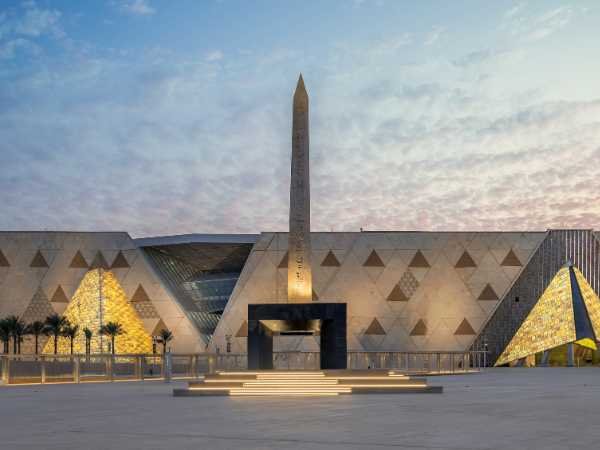

The Grand Egyptian Museum (GEM) represents a major turning point for Egypt’s tourism industry. With its official opening in 2025, it has become more than just a museum; it is a global cultural icon and a beacon attracting millions of visitors from around the world. This article highlights the multi-faceted impact of the Grand Egyptian Museum, how it is reshaping Egypt’s tourism landscape, boosting the economy, and reviving interest in ancient Egyptian civilization.
A Quick Overview of the Grand Egyptian Museum
The Museum's Strategic Location
Massive Space and Unique Design
Located on the Giza Plateau, just two kilometers from the Giza Pyramids, the Grand Egyptian Museum creates a unique visual dialogue between modern architecture and ancient heritage. It is not just a building but a massive complex spanning 500,000 square meters, making it the largest museum in the world dedicated to a single civilization.
The museum houses a stunning collection of approximately 100,000 artifacts, including the complete contents of Tutankhamun’s tomb for the first time since its discovery.
A Walkway Connecting the Museum to the Pyramids
There is now a 1.27-kilometer pedestrian pathway. This path directly connects the museum to the pyramids. This has significantly improved the visitor experience.
The Direct Impact on Tourist Traffic and Visitor Numbers
How the GEM is Reshaping Visitor Numbers and Expectations
From its opening day, the Grand Egyptian Museum proved to be a formidable attraction. It welcomed an average of 19,000 visitors daily in its first week. Projections indicate that if it maintains this momentum, it could exceed 6.9 million visitors annually, placing it among the world’s most visited museums like the Louvre (8.9 million) and the British Museum (5.8 million).
This massive influx of visitors directly contributes to achieving Egypt’s National Tourism Strategy, which aims to attract 30 million tourists by 2030. The museum alone is expected to attract an additional 7 million visitors annually.
Economic Stimulus and the Spread of Tourism Benefits
The impact of the GEM extends far beyond entry tickets, reaching wide economic sectors:
Hotel Construction: The government allocated EGP 50 billion for hotel construction in 2023 alone, adding thousands of new rooms.
Infrastructure Development: Airports like Sphinx International Airport have seen expanded flights, especially by low-cost carriers.
Extended Stays: Cultural tourism, represented by the museum, has become a central attraction. Tour operators are now extending their packages from 7 to 9 days to include visits to the museum and the Pyramids, meaning significantly higher tourist spending. Many of these extended itineraries now combine Cairo with popular Red Sea resorts like Sharm El-Sheikh, creating a more diverse travel experience.
Figures show that cultural tourists tend to stay longer and spend more money compared to beach tourists, multiplying the positive economic impact.
The Construction Journey: From Planning to Opening
The path to opening the Grand Egyptian Museum was long and arduous, spanning nearly 25 years. The idea began in the 1990s, the foundation stone was laid in 2002, and the project faced significant challenges, including the political turmoil of 2011, financial difficulties, and the COVID-19 pandemic. However, thanks to political will and international support, the dream was realized, and the museum officially opened in November 2025, standing as a testament to Egypt’s determination to preserve its heritage.
Conclusion
The Grand Egyptian Museum is more than just a museum; it is a catalyst for development and a symbol of Egypt’s powerful resurgence on the global tourism map. By combining ancient heritage with modern architectural design, the museum has not only succeeded in displaying history but has also created a brighter future for Egyptian tourism and the economy. It is truly the crown jewel, redefining the concept of cultural tourism in Egypt in the 21st century.

Pricing Strategy Cost Shock – Is 10% Enough?
Discover how a 10% pricing strategy cost shock impacts margins. Learn the 9.09% break-even point and optimal price. Download the...
Read MoreA 10% Cost Shock: Is a 10% Price Rise Really the Best Response?
When costs go up, raising prices by the exact same percentage feels logical. But demand elasticity changes the math entirely. Discover why a 10% cost shock requires a more nuanced pricing strategy.
1. The 9.09% Tipping Point: Navigating the Pricing Strategy Cost Shock
If you raise your price by 10%, you can only afford to lose 9.09% of your sales volume before your contribution margin drops below pre-shock levels. Here is the break-even math.
2. The Pricing Equation: Why a Proportional Cost Shock Doesn’t Equal a Proportional Price Increase
Contribution = Quantity × (Price – Cost). We analyze a real-world scenario: when unit costs jump from EGP 70 to EGP 77, a price increase to EGP 110 looks good on paper—but what happens if demand falls?
3. Elasticity Changes the Outcome: 4 Market Scenarios
Published averages describe distinct markets, not universal forecasts. See how different elasticities impact your bottom line:
Optimistic (-0.50): Maintains high volume.
Food-away (-0.81): Moderate volume loss.
Unit elastic (-1.00): Exact proportional loss.
Brand-level (-2.62): Severe volume loss.
4. The Highest Contribution May Be Above 10%
At a brand-level elasticity of -2.62, the markup rule suggests an optimal selling price of EGP 124.53. But even at this optimal price, you only recover part of the cost shock (EGP 267.5k vs. the original EGP 300k). Pricing cannot always fully offset the damage.
5. Own-Cost Shock vs. Sector-Wide Shock: The Competitor Factor
If your competitors face the same cost shock, a brand-level elasticity of -2.62 may overstate your losses. If everyone raises prices, relative prices move less, and you keep more volume.
6. The Hidden Cost of Delaying a Price Increase
Delaying a 10% price adjustment for 30 or 90 days isn’t free. At an elasticity of -0.81, a 90-day delay in repricing could cost you EGP 226k in forgone contribution.
7. What Companies Should Actually Model
Stop relying on universal pass-through rates. Build a decision-ready framework that tests price, demand, and timing jointly:
Own price / cost
Market position (Relative price)
Demand response (Elasticities)
Timing / liquidity (90-day exposure)
Data sourced from Federal Reserve FEDS 2026-069, Journal of Marketing Research (Bijmolt et al.)
For more reports and insights, explore our [MENA Consulting Services] or browse our [All Market Reports].