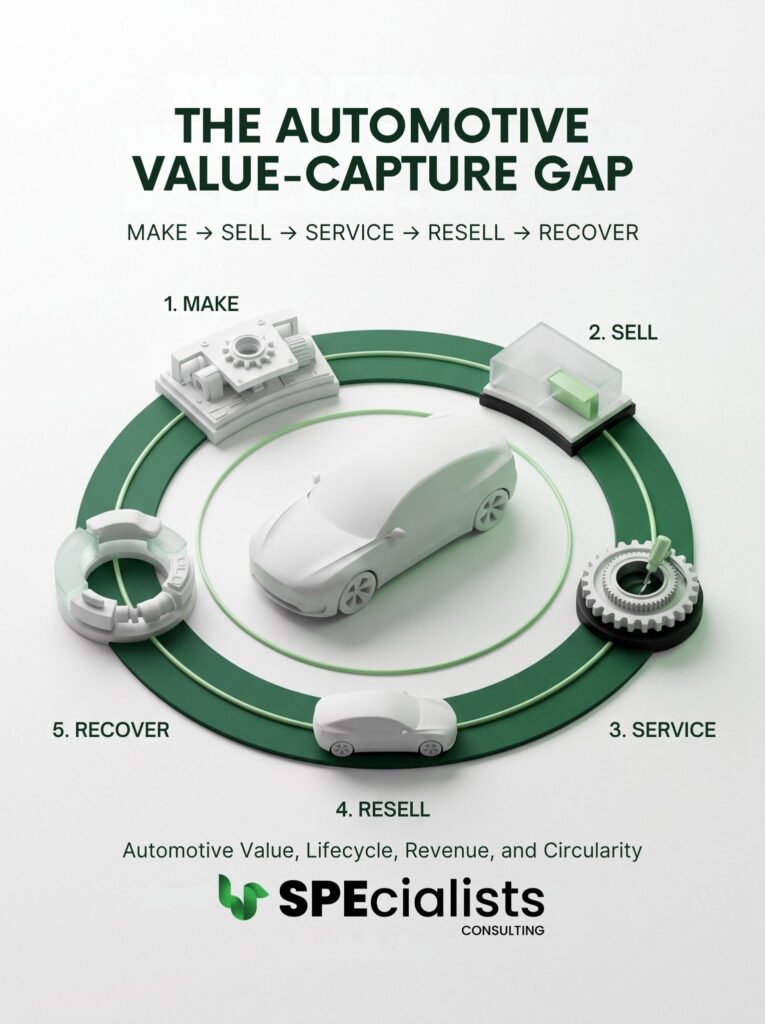
The Automotive Value-Capture Gap: Why the Next Opportunity Is Not Selling More Cars – But Capturing More Value from Every Car
Introduction
The automotive value capture 2026 is shifting from selling more cars to capturing more value from every car. This report explores the value-capture gap across five markets – Egypt, Saudi Arabia, USA, Morocco, and South Africa – and shows why the next investment cycle will be about lifecycle value, not just vehicle volume.
Key Sections & Headings
1. Automotive Value Capture 2026: The Car as a Recurring Economic Platform
The strategic question shifts from market size to domestic value retained per vehicle.
2. Linear Capture vs. Lifecycle Capture: Two Economies, Same Vehicle, Radically Different Value
Linear Capture: Import → Sell → Tax – downstream value leaks outside the formal ecosystem.
Lifecycle Capture: Build → Service → Resell → Recover – aftermarket, secondary, and recovery markets become formal economic layers.
3. The Value-Capture Spectrum Is Global – But Every Economy Captures Different Layers
From integrated powerhouse (USA, Germany, Japan) to large consumer market (Egypt, India) – the question is: where does lifecycle value stay local?
4. Where Does the Value Go After the Car Is Sold?
The vehicle becomes a lifecycle value platform: parts, repair, finance, used car, used parts, materials – each stage creates a value pool and a potential leakage point.
5. Five Markets. One Lifecycle Lens: Egypt, Saudi Arabia, USA, Morocco, South Africa
A comparable map of installed fleet, new vehicle sales, manufacturing depth, components, aftermarket, used cars, exports, and end-of-life.
6. The Strategic Gap Is Ecosystem Depth – Not Simply Market Size
A qualitative heatmap showing where value pools are established, developing, or show a significant capture gap.
7. Egypt’s Opportunity: Monetize the 11.05M Installed Base – Not Just Expand Assembly
11.05M licensed vehicles
$7.53B used-car market activity estimate
$0.76B aftermarket services estimate
The missing piece: deeper, measurable domestic capture.
8. The Benchmark Is Not ‘More Factories’. It Is Deeper Value Capture Around Every Vehicle
Morocco and South Africa show how manufacturing becomes more valuable when supplier, export, and employment ecosystems deepen.
9. Saudi Arabia Is Building a Full Automotive Ecosystem – From Assembly to Components
860K vehicles sold in 2024
600K production target by 2035
40% local GVA target
$5.67B aftermarket estimate
10. Where Is the Next $1 of Automotive Value Likely to Come From?
The answer depends on where a market sits on the value-capture spectrum: mature economies, export-oriented hubs, large consumer markets, localization transitions, or circularity frontiers.
11. The Next Automotive Investment Cycle: Five Priority Value Pools
Supplier localization
Aftermarket formalization
Used-car infrastructure
End-of-life economy
Lifecycle data
The strategic KPI should evolve from “cars sold” → “value captured per car”.
12. Automotive Value Capture (AVC): Six Questions for Any Country
Can we build?
Can we supply?
Can we service?
Can we resell?
Can we recover?
Can we export?
Output: a country profile of domestic value capture – not a league table.
13. The Winning Automotive Economy Is Not Necessarily the One That Sells the Most Cars
It is the one that captures the most value from each car – across its entire economic life.
14. Appendix: Methodology & Sources – How to Read the Evidence
Scope discipline is part of the insight: comparable figures are compared; non-comparable figures are explicitly labeled.
According to IEA’s 2025 report, the global car market is valued at ~$2.9 trillion. The OECD’s 2024 value-chain analysis frames the shift from upstream materials to services and recycled components. The European Commission’s ELV Regulation (2026) sets circularity and traceability requirements across the vehicle lifecycle.
For more reports and insights, explore our [MENA Consulting Services] or browse our [All Market Reports].
Download Now